The History of … “The Sting”

Image result for picture of movie the sting"

The movie The Sting came out in the 1970’s.  It is a story about fun loving con artists who successfully fool gangster Doyle Lonnegan with a trick called “the wire.”  What some may not know is that the con in the movie was probably invented by a real person, Joseph Weil. 

Joseph Weil died at the age of 100 in 1976.  He estimated that, over the course of his life, he made about 8 million dollars conning people mostly in and around Chicago, Illinois.  He justified his actions saying that he never conned anyone who was not greedy.  He said about his victims, “Every victim of one of my schemes had larceny in his heart.  An honest man would have had no part of any of my schemes.  They all wanted something for nothing.”

Weil started his career in his early 20s selling Merriweather’s Elixir as a cure-all.  Its chief ingredient was water.  He acted as person in the crowd who would attest falsely to the curative powers of “Doc” Merriweather’s tonic.  Soon after the turn of the century he got his nickname, the Yellow Kid, after a comic that his partner at the time liked.  The Yellow Kid was a goofy sidekick to one of the main characters.   Weil got better and better at swindling people and was able to mostly skirt the law because, at the time, Chicago law was that a swindle could only be done on an innocent person.  He, therefore did a lot of his work in and around racetracks.

His con “the wire” which was the big take down used in The Sting involved setting up a fake gambling house with pretend employees and gamblers.  His mark was convinced it was a real setting and that Joseph had bribed a Western Union operator to slow transmissions of race winners so that Weil could get the results of a race beforehand and place successful bets.

Some of his other big “achievements” allegedly were to take Italian dictator Benito Mussolini for 2 million dollars, sell a talking dog, and convincing people to buy oil-rich land that he did not own.  Over his life time Weil served about six years in jail but kept all of his swindled money.  He died a free man.

The History of … Superheroes

Superhero in City: Superhero watching over the city.

The word superhero was first used generically in 1917 to refer to real people who had great ability and achievements.  In the 1940s, however, the word became forever associated with the “costumed characters” of comic books.

The first of these superhero comic book characters was Superman who made his debut in 1938 in Action Comics #1.  However, for historians, the question is was Superman the first real superhero or just the latest in a long line of the super powered?  After all, the Greek and Roman gods all had special powers, costumes and background stories.  Additionally, masked men with secret identities came before Superman.  Characters like Robin Hood, the Scarlet Pimpernel, Zorro, Gladiator, Doc Savage, the Spider, the Phantom, the Clock and the Shadow preceded him.  Additionally there was Nyctalope in France circa 1911 and Ogon Bat in Japan from 1931 who had special powers.

It really boils down to definition.  What is a Superhero?  The best definition I could find comes from Superhero:  The Secret Origin of a Genre by Peter Coogan which says a superhero is, “A heroic character with a selfless, pro-social mission; with superpowers—extraordinary abilities, advanced technology, or highly developed physical, mental, or mystical skills; who has a superhero identity embodied in a codename and iconic costume, which typically express his biography, character, powers or origin (transformation from ordinary person to superhero); and who is generally distinct, i.e. can be distinguished from characters of related genres (fantasy, science fiction, detective, etc.) by a preponderance of generic conventions.  Often superheroes have dual identities, the ordinary one of which is usually a closely guarded secret.”

This definition would eliminate Greek and Roman mythology because those gods were not trying to do good works for others.  It would also eliminate the “masked men” and crime fighters that came before Superman because they were just men or had not developed themselves into superheroes like Batman.

For historical purposes the definition gets pretty convoluted and sounds more like a way of eliminating heroes prior to Superman.  After all Superman wasn’t even called a superhero until the 1940s.  He was first a “mystery man” and a “costumed character.”

I think a better way to approach the history of superheroes is to acknowledge that a superhero is someone with special powers (either developed or gifted) who usually has a secret identity, costume and is trying to do good things in the world.  This would include heroes prior to Superman who hid their identity and tried to help people but would exclude the gods of Greek and Roman mythology.

This difference then between the superheroes that came before Superman and Superman comes from effect.  Through comics Superman became an international phenomenon that led to many more superheroes.  Therefore, while he may not have been the first superhero, Superman is rightly given the title of first superhero in importance because of his impact in bringing the idea of the superhero to prominence.

From the time of Superman superheroes spread through the Golden Age of comics with the invention of Wonder Woman, Batman, the Green Lantern, and Captain America who all fought the Axis powers.  There was a dip in interest in superheroes after World War II until the late 1950’s when the so called Silver Age of comics occurred.  It brought the Justice League, Fantastic Four and X-men to audiences everywhere.  Televisions shows about superheroes widened their appeal as well.  In the 1980s darker anti-heroes emerged in superheroes like the Watchmen but classics like Superman, Wonder Woman and Batman enjoyed repeated revivals on television and in movies until the present.

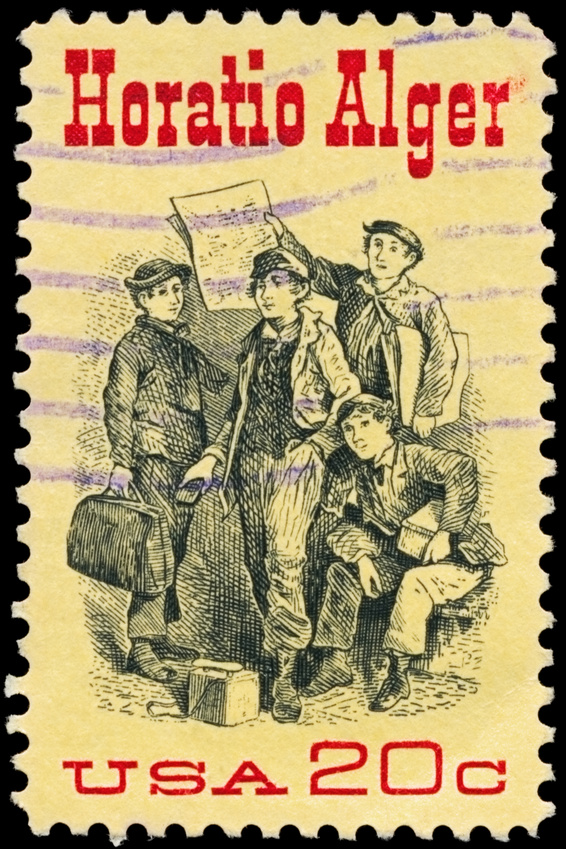
The History of … Horatio Alger

Have you ever noticed that when politicians are running for office they have a story to tell about how they grew up?  It usually involves how they came up from nothing, or if that is not true, it is about the hardships they conquered to get where they are.  The idea of mobility is part of the American ideal.  Stories that start with a hard scrabble childhood and lead to vast riches and success through perseverance and hard work are popular with the American people.  Politicians like to play into that as much as possible in an attempt to have us like them.  

These stories are found throughout American history.  Benjamin Franklin, Stephen Girard, Marshall Field, Abraham Lincoln, Andrew Carnegie, James Garfield, John Rockefeller, Sam Walton, Oprah Winfrey, and R. A. Dickey are just a few examples of people who rose to great success from humble beginnings.

The man who popularized those stories of American rags to riches, Horatio Alger, is less well known today than the idea associated with his name.  Horatio Alger was a 19th century writer whose tales of hard luck youth rising up are often linked to the value of social and economic mobility that many associate with the United States American dream.

Horatio Alger was born on January 13th, 1832 to a Unitarian Minister in Chelsea, Massachusetts.  He grew up in genteel poverty, well-educated and of the right background but with financial concerns.  In 1845 his family moved from Chelsea to a new church in Marlborough, Massachusetts after a bankruptcy.  Things went a bit better in Marlborough and young Horatio was able to attend a local preparatory school, Gates Academy, so that he could try and pass college entrance exams.  Young Alger also began writing poems and stories during these years that he was able to publish in local papers.

Horatio Alger passed entrance exams for Harvard College in 1848.  He did well in his studies there and continued to write.  Several of his pieces were published in national magazines.  While at Harvard, he also determined that he wanted to be a poet or, secondarily, a literary writer.

As is often the case with college graduates, after his commencement in 1852, Horatio Alger’s desires met reality and they had to be revised.  While he was able to get pieces published, both poetry and stories, he was not able to earn a living as a writer.  Therefore, Alger broadened the magazines he applied to and worked on pieces that were less literary.  He also sought other means of employment.  

Alger briefly returned to Harvard to contemplate his next steps and wound up taking a job at a paper in Boston.  He lasted a couple months editing copy, but he did not think he was suited for newspaper work.  He finally took a job teaching at a boarding school and continued to write on the side.  He was successful at getting stories published in magazines and even had a book of poetry published that received good reviews but did lousy sales.

When the school where he was working closed, Alger took a summer position as principal of another school and then returned to Boston and worked as a private tutor.  He continued to be published in respected local and national magazines.  He put out another book of poetry.  Still, he was unable to earn a living as a writer.  He finally decided to follow his father into the ministry.

Alger went back to Harvard and graduated from the Theological School in 1860.  During the Civil War Alger was drafted and then rejected for service due to his nearsightedness and his short stature.  Instead, he wrote poems and articles in favor of the Union cause.  It was during the Civil War years that he also made an important decision.  Alger acknowledged to himself and others that his dream of literary success would not be realized and he decided to write children’s books in an attempt to achieve financial success as a writer. 

Horatio Alger took a job as a pastor at First Unitarian Church in Brewster, Massachusetts in 1864.  The job as a minister led to the most disturbing incident of his life and career.  Alger’s personal papers were destroyed at his request upon his death so his part of the tale will never be known.  Letters from the church to others indicate that he left his position in 1866 because of a scandal.  He was accused of some kind of sexual misconduct with one or more boys in his parish.  Alger left the post immediately and his Father stepped in to save his reputation.

The parish was at first uncertain how to handle the crisis.  A letter from Alger’s Father, which did not deny the charges, proposed that Alger would never again work as a minister if charges were not pressed against him.  Again, Alger’s papers were destroyed, but it does not appear that he denied the charges and he never served as a minister again, even though he took jobs later in life to supplement his writing income.

After the scandal, Horatio Alger moved to New York City and for the first time was able to eke out a living as a writer.  His decision during the Civil War to turn to children’s fiction had begun to pay off before the scandal in Brewster.  He was able to get his first children’s book, Frank’s Campaign, published in late 1864 and it was considered a financial success. 

Over the next three years he wrote three more children’s books which were well received but not big money makers.  In 1867 he wrote a story for Student and Schoolmate magazine titled Ragged Dick; or Street Life in New York. It was later developed into a book which became Alger’s greatest financial success and the basis for the bulk of the rest of his career.  Ragged Dick is the tale of a young boy who shines shoes for a living; he is a boot-black.  While the young boy, Dick, is homeless and lives a tough life, he maintains his moral compass and eventually that leads to his reaching the lowest rung on the ladder of success.  He becomes a respectable young man in a counting house. 

Ragged Dick was the peak of Alger’s writing career.  Alger struck while the iron was hot and churned out story after story following the successful formula of the first book.  This formula was simple; a young boy through hard work and morality gets a break (usually from a wealthy older gentleman) and is able to go from poverty to the first rung of respectability.  His stories were not, in fact, about moving to great riches, just to the first rung of the ladder.  It was only after Alger’s death that the connection to his name came to be associated with the idea of rags to riches.

The formula worked for the next several years, but never achieved the financial success of the original.  Sales fell off and tastes changed.  Alger tried writing with limited success in a more sensational style.   Eventually, he had to take employment as a tutor to supplement his writing.  His tutoring was successful and he was good at getting his pupils into elite schools. 

At various points Alger tried to publish adult writing, sometimes seeing positive reviews but never selling well.  Alger focused on quantity of writing to maximize his earnings.  As a result, his work was sometime accused of being sloppy.  He wrote a biography for children of President James Garfield immediately after Garfield’s death in 1881 that sold well, however, it was not researched and contained many errors.  After two hastily prepared biographies of Abraham Lincoln and Daniel Webster, Alger gave up the practice.

There were no more sexual scandals in Alger’s life or, it appears, accusations of misconduct.  Alger never married.  He became known for his charity work once he moved to New York City.  He raised money for boy’s houses and tried to help orphans.  This work is, of course, now colored by the information about his time at the Brewster church. 

Horatio Alger worked up until 1896, three years before his death.  His passing was not widely mourned.  However, his writing experienced resurgence at the turn of the century until the 1920s.  He sold more books during that period than he had sold during his lifetime.  The idea of the Horatio Alger hero surpassed the actual man in life.  A set of awards, the Horatio Alger Awards, is still given out annually in honor of people who, despite adversity, rise through the free market. 

The History of … Dieting for Weight Control

New Year, New Year’s resolutions, let the dieting begin!  But first, wouldn’t it be fun to look at The History of … Dieting for Weight Control (maybe while enjoying one last slightly stale Christmas cookie…).

The word diet comes from the Greek word diaita meaning manner of living.  Today a diet is a way of eating either for preference, for health or to lose weight. 

Dieting has occurred throughout history for various religious and health reasons.  Among the elite or rich there was always some interest and writing about diet as an overall way of living.  This included a desire to combat obesity.  However, dieting to specifically lose weight is, for the bulk of humanity, principally a modern phenomenon.

For most of human history the search for food occurred for survival and that was our primary relationship with food.  In fact, often being plump or overweight was a sign of great beauty because it meant a person was healthy.  However, in the 19th century industrialization produced a large middle class.  This had many consequences.  Among them was that as people moved from farms to cities they began eating different kinds of foods and could afford more.  They were no longer living at subsistence levels so weight gain was possible.

During the Victorian Era in the United States (1837-1901), some members of the growing middle class were wealthy enough to allow mothers to stay at home and care for children.  They could also afford mirrors in their homes which were finally being mass-produced at affordable rates and they had some free time for self-reflection.  Additionally, disposable income meant the ability to afford some non-essentials, like pretty clothes.

Outside forces contributed, during this general period, to a widespread ideal of what a person should look like.  With a bit more leisure time and money people could read newspapers which had pictures and women’s magazines with ads and articles promoting the best figure.

Dresses became mass-produced by the turn of the century as opposed to specifically made for one person’s body.  Eventually, by the 1920s, standard dress sizes were introduced.  This also happened with bras as they replaced corsets.  There was now a model of what a person should look like, the implements to evaluate yourself within your home and now standard clothes a person had to fit into that placed an evaluation on that person (i.e. you are a size 8).

Medical advancements contributed to a population more conscious of diet with the discovery of calories in the 1800s and more wide knowledge about the nutritional value of foods.  Additionally, by the early 1900s, weight charts showing average weights based on height were obtained from life insurance companies and published. Several years after that, tables of correct weights for height were created. In the 1870s weighing scale companies began producing machines for people as well as for foods.  Penny scales appeared in public.  Bathroom scales followed after the First World War.

Now being the right weight was medically, as well as visually, important and knowledge existed about how to achieve your appropriate size.  The only thing needed was the right guru to put together the desire to be the correct weight to look good and fit into clothes.

Many such gurus emerged and the modern diet industry was born in the 1800s.  Some of the early notables were Banting, Fletcher, Peters and Hay.

The Banting System was introduced to the world by William Banting in an 1863 book called Letter on Corpulence, Addressed to the Public that he self-published.  It sold worldwide.  It was a precursor diet to the Salisbury Method and then the Atkins diet.  William Banting was an undertaker who needed to lose weight.  His idea, devised by a local ear, nose and throat Doctor, was to reduce the amount of carbohydrates in his diet.  The method was used well into the 1920s, even getting a mention in some of Agatha Christie’s mysteries.  The diet was so popular it became a verb.  Instead of saying you were dieting you would say you were ‘banting.’

Horace Fletcher (1849-1914) was a businessman whose idea for dieting was to chew each bite of your food until it liquefied.  Fletcherism became an activity as well as a diet and was very popular.  Notables such as John D. Rockefeller, Franz Kafka and Henry James were devotees.

In 1918 a Doctor named Lulu Hunt Peters published a best-selling book on dieting and calories.  She was among the first to popularize the use of calories in dieting in the US.  Later she wrote the first calorie counting book for kids.  She was a physician from California who had lost weight herself. 

The Hay Diet was named for Dr. William Hay who came up with a diet that was the precursor to the Beverly Hills Diet of the 1980s.  His 1930s diet involved aspects of Fletcherism, as well as, separating foods (eating protein, fruit, and starches at different meals).  It was practiced by Henry Ford.

Inevitably, backlash against this new emphasis on dieting for weight control emerged.  Many Doctors spoke out and continue to speak out against fad dieting.  By the 1920s, warnings about dangerous dieting were a part of the Progressive Era’s medical programs.  The American Medical Association’s (AMA) conference on adult weight met in 1926 to determine what healthy weights were and voiced concern about the ‘barber pole figure’ of the 1920s.  While the term anorexia nervosa was first used in the 1800s (and before that existed but was not categorized) it became widely known in the late 1970s and early 1980s, particularly after the singer Karen Carpenter’s death.

However, despite the warnings, dieting for weight control continued and expanded throughout the 1900s and to today.  Cigarettes were advertised in the 20th century as a way to make a person thin.  Cosmetic surgery by ‘beauty surgeons’  also grew in the 20th century.  The first diet foods were introduced in the 1950s.  Weight Watchers was started in 1963.  Today, a popular book website has over 100,000 books for sale on diet and dieting.

The History of … Popular Western Nursery Rhymes

Parents have always used song and rhyme to entertain and soothe their children.  Our modern nursery rhymes have their origins in the last couple hundred years from Western Europe.  I had fun discovering the sources of some of the ones my kids and I like.  While a few of the origins of our favorite rhymes are well accepted and documented, others veer more toward the legend category or have several explanations.  I tried to indicate how firm the ‘history of’ is for each rhyme.

The rhyme “Jack Sprat” is a purported reference to the younger brother of King Richard I of England, John.  Both Richard and John are well known today because they figure in the fictional tale of Robin Hood.  John was cast as the villain, trying to usurp the throne from Richard the Lionheart while he was away fighting in the Crusades.  While Robin Hood is a fictional story it did correctly portray that John was not a beloved figure.  He was widely disliked for his lack of military success and because he was believed to have tried to take the throne from Richard.  The rhyme therefore refers to John and his wife Isabella taking so much in taxes that they “licked the plate clean.”

Jack Spratt could eat no fat,
His wife could eat no lean,
And so between them both
They licked the platter clean.

The rhyme “Baa Baa Black Sheep” is commonly thought to celebrate England’s very important wool industry.  There are suggestions that it contains political statements.  The original rhyme, prior to its 1765 publishing in “Mother Goose’s Melody,” had the last two lines as “two thirds to the dame and none to the little boy who cries in the lane.”  These previous lines are believed to refer to the tax on wool that the English King Edward I, known as “Longshanks,” initiated in 1275.  The poem was a complaint that none of the money from shepherding went to the shepherd since one third went to the king and two thirds went to the dame (the church).

Baa baa black sheep, have you any wool?
Yes sir, yes sir, three bags full,
One for the master, one for the dame,
And one for the little boy who lives down the lane.

There is some disagreement about the origins of  “Ring Around a Rosie.”  In the past it was understood to be about the Black Plague or the Great Mortality which killed a third of Europe in the 14th century (as well as a third of the Middle East and most likely China).  This claim has been more recently disputed because no record of it was made until the 19th century.  It is now starting to be understood as nothing more than a nonsensical children’s rhyme but there is disagreement.

Ring around a rosie
A pocket full of posies
Ashes, ashes
We all fall down.

If “Ring Around a Rosie” does indeed reference the Plague there are several different versions of its meaning.  One is that the rosie means rosary beads to pray to not get sick.  Posies are flowers to keep the smell of dead bodies at bay or (for some) to try and prevent contagion (for those who thought bad smells transmitted it).  Ashes refer to burning bodies when there were too many to bury and the last sentence is about dying.  Another interpretation has the ring around the rosie referencing bruise-like purple splotches which were a part of bubonic plague.

Cardinal Thomas Wolsey is famous in history for failing to secure Henry VIII of England a divorce from his first wife so he could marry his mistress.  Eventually Henry VIII broke from the Catholic church over the divorce and started his own church.  Wolsey’s failure with the divorce is documented in “Old Mother Hubbard” with the bone being the divorce.

Old Mother Hubbard
Went to the cupboard
To get her poor doggie a bone,
When she got there
The cupboard was bare
So the poor little doggie had none.

“Three Blind Mice” possibly comes from the reign of Queen Mary I.  She was a Catholic who wanted to restore the Catholic church in England and therefore persecuted Protestants.  Because of her vast farm estates she was referred to as the farmer’s wife.  The three blind mice were three men of noble birth who plotted against her.  She had them tortured and burned at the stake.

Three blind mice, three blind mice,
See how they run, see how they run,
They all ran after the farmer’s wife,
She cut off their tails with a carving knife,
Did you ever see such a sight in your life as three blind mice?

Queen Mary I is also featured in “Mary Mary Quite Contrary.”  Her detractors called her ‘Bloody Mary’ because of her persecution of Protestants.  The poem talks about torture and death.  Silver bells and cockleshells were torture devices while “maids in a row” refers to her use of one of the precursors to the guillotine, called a maiden.

Mary Mary quite contrary,
How does your garden grow?
With silver bells and cockle shells
And pretty maids all in a row.

In “Rain Rain Go Away” the Spanish fleet is taunted by the English who, under Queen Elizabeth I, vanquished the Spanish armada in 1588 because they better understood the unpredictable weather in the English Channel.  Sir Francis Drake famously waited and waited to launch against the approaching Spanish because he saw the weather was worsening.  When he finally did launch, his ships were able to out maneuver the Spanish and won the day.  Johnny was a term used to describe Englishmen.

Rain, rain, go away,
Come back again another day;
Little Johnny wants to play.
Rain, rain go to Spain,
Never show your face again.

“Goosey Goosey Gander” dates to the 16th century.  It appears to refer to ‘priest holes’ which were secret rooms where Catholic priests could hide from persecution from Protestants during the reign of Elizabeth I.  They were threatened with death if they practiced their faith.  When the rhyme talks about an old man who would not say his prayers it means a priest who would not say prayers in the Protestant manner (English verses Latin) or swear allegiance to the Queen.

Goosey Goosey Gander where shall I wander,
Upstairs, downstairs and in my lady’s chamber
There I met an old man who wouldn’t say his prayers,
I took him by the left leg and threw him down the stairs.

Sometimes rhymes were used as a way of passing information.  In an age where news of battle wins and losses could take weeks and months to hear, an easily remembered rhyme was a reasonable way to get news out.  In the case of “Remember, Remember the Fifth of November” it was a way to get a punishment known as well.

In 1605 Englishman Robert Catesby and his band of terrorists, which included the infamous Guy Fawkes, tried and failed to blow up the Parliament building on the first day of its new session.  If successful, their plan would have resulted in the deaths of most of the governing elite, including King James I.  The plot was learned of when a member of the gang told a family member not to go to Parliament that day and that person tipped off the authorities.  Fawkes was discovered hiding in the Parliament cellar waiting for morning to light the fuses.  The rhyme was created as a way of commemorating the foiling of the plot and as a reminder of the dangers of high treason.

Remember, remember the fifth of November,
Gunpowder, treason and plot;
I see no reason why gunpowder, treason
Should ever be forgot.

Guy Fawkes, Guy Fawkes, it was his intent
To blow up the King and the Parliament;
Three score barrels of powder below,
Poor old England to overthrow.

By God’s providence he was catch’d
With dark lantern and lighted match;
Holler boys, holler boys, make the bells ring,
Holler boys, holler boys, God save the King.

In the 17th Century George Villiers, 1st Duke of Buckingham was a notorious scoundrel.  His affair with the queen of France was featured in the story “The Three Musketeers.”  He enjoyed the favor of the King of England, James I and was therefore mostly protected from his bad behavior.  His sexual conquests and fear of retribution “when the boys came out to play Georgie Porgie ran away” are referenced in the rhyme “Georgie Porgie.”

Georgie Porgie pudding and pie,
Kissed the girls and made them cry
When the boys came out to play,
Georgie Porgie ran away.

We all know the classic nursery rhyme “Humpty Dumpty.”  It is possible that Humpty Dumpty was a canon used during the English Civil War in the 17th century.  Calling someone Humpty Dumpty was a slang term for fat.  In the case of the rhyme it refers to a huge cannon used by the Royalists to defend the strategically key town of Colchester.  When the Roundheads (which refers to the close cropped hair of the Puritans) or Parliamentarians were able to damage the wall underneath the Royalists huge cannon Humpty Dumpty they were unable to move it to another wall and thus eventually lost the town.  Hence:

Humpty Dumpty sat on a wall,
Humpty Dumpty had a great fall.
All the King’s horses, And all the King’s men
Couldn’t put Humpty together again!

So why then do we know Humpty as an egg?  One of the first references seems to be in Lewis Carroll’s late 19th century story, “Through the Looking Glass” in which Alice has a deep conversation with Humpty Dumpty ‘through the looking glass’ as put back together in the form of an egg high up on a wall.

Oliver Cromwell was the leader of England from 1649-1660.  He was the last person to rule it as a republic.  There was much surprise when he appointed his rather unaccomplished son, Richard to succeed him.  Richard was not up to the job and only served a year before he was removed.  “Hickory, Dickory, Dock” may record his short duration in office.  The clock striking one marks the one year he served.  One of his nicknames was Hickory Dick.

Hickory, dickory dock,
The mouse ran up the clock.
The clock struck one,
The mouse ran down,
Hickory, dickory, dock.

In 17th century England “Matthew, Mark, Luke, and John” was used to ward off evil spirits on Twelfth Night (the 12th day of Christmas, January 5th).  It was repeated three times.

There are four corners at my bed,
There are four angels there.
Matthew, Mark, Luke, and John,
God bless the bed that I lay on.

The nursery rhyme “Boys and Girls Come Out to Play” was published in 1708.  It was written during a time when most children in England worked all day, usually for their parents on a farm and later in factories.  Only wealthy children were educated.  The rhyme is about kids going out to play when the work day was done.

Boys and girls come out to play,
The moon does shine as bright as day;
Come with a hoop, and come with a call,
Come with a good will or not at all
Lose your supper, and lose your sleep,
Come to your playfellows in the street;
Up the ladder and down the wall.
A halfpenny loaf will serve us all.
But when the loaf is gone, what will you do?
Those who would eat must work – ‘tis true.’

It is possible that the rhyme “There was an Old Woman Who Lived in a Shoe” was made about the English King George II who reigned from 1683 to 1760.  He ruled at a time when Parliament was strong and the country’s economy was in a downturn.  Therefore, in the rhyme the King is the old woman and the Parliament are the children.  Giving them broth without bread refers to the King’s attempt at austerity and sending the children to bed refers to forcing them to attend Parliament sessions daily.

There was an old woman who lived in a shoe,
She had so many children she didn’t know what to do;
So she gave them some broth without any bread,
And she whipped them all soundly and sent them to bed.

The character Mother Goose was first mentioned in French writings in the 17th century, although not connected to the rhymes we associate with Mother Goose today.  In the 18th century in England Mother Goose started to be associated with many of the rhymes we now know.  Curiously she was depicted as an old lady flying on a Goose.  This indicates some association with witchcraft and magic.  During the time of her origination, natural disasters, disease, and life’s other hardships were sometimes explained by witchcraft.  The first Mother Goose had many of the characteristics of a witch; she was an old lady living alone, she had the ability to fly on her goose, and she was associated with an animal that worked for her.  Kids of the time would have been familiar with this connection.

Old Mother Goose
When she wanted to wander
Would fly through the air
On a very fine gander.

Mother Goose had a house;
It stood in the wood
Where an owl at the door
As sentinel stood.

“Rock-a-bye Baby” is a classic children’s lullaby, also sometimes recited as a nursery rhyme.  It originated in America and a version of it was first published in the 18th century.  It appears to have come from the practice of a few American Indians who would put their children in cradles made of tree bark and suspend them from tree branches to let the wind rock their babies to sleep.

Rock-a-bye Baby, on the tree top,
When the wind blows the cradle will rock;
When the bough breaks, the cradle will fall,
And down will come baby, cradle and all.

The poem Jack and Jill originates from the time of the French Revolution and possibly refers to the beheading of King Louis XVI and his wife who “tumbled after.”  The ending is cleaned up for kids with Jack caring for his hurt head in a manner common at that time.

Jack and Jill went up the hill to fetch a pail of water
Jack fell down and broke his crown
And Jill came tumbling after.

Up Jack got, and home did trot
As fast as he could caper
He went to bed and bound his head
With vinegar and brown paper.

The French rhyme “Frere Jacques,” meant to be sung in a round, translates to “Brother John” and is believed to be about a monk being told to ring the bells for morning prayers.  The French version is first and then the translation.

Frere Jacques, Frere Jacques
Dormez-vous, dormez-vous?
Sonnez les matines, sonnez les matines!
Din, din, don, din, din, don.

Brother John, Brother John,
Are you sleeping, are you sleeping?
Ring the morning bells, ring the morning bells!
Ding, dang dong, ding, dang dong.

Helping kids to eat healthy foods was the purpose of “An Apple a Day.”  Its authorship is unknown.  It was first mentioned in print in 1866.

An apple a day keeps the doctor away
Apple in the morning – Doctor’s warning
Roast apple at night – Starves the doctor outright
Eat an apple going to bed – Knock the doctor on the head
Three each day, seven days a week – Ruddy apple, ruddy cheek.

Our final rhyme, “Christmas is Coming,” reminds kids about the importance of generous giving during the Christmas season.  It also is a fun lesson about the penny.  Initially, the penny had a Christian cross on the back.  This allowed the coin to be cut appropriately, in half for a halfpenny and in quarters for a farthing.

Christmas is coming, the goose is getting fat
Please do put a penny in the old man’s hat;
If you haven’t got a penny, a ha’penny will do,
If you haven’t got a ha’penny then God bless you!


The History of … The Circuitous Writing Path of Alex Haley

I guest blogged over at www.Shaynagier.com the other day (5/12/12) about how Alex Haley, author of “The Autobiography of Malcolm X” and “Roots:  The Saga of An American Family,” came to be a writer.  It all started for Haley with his writing of love letters to his shipmates’ girlfriends!

Alex Haley enlisted in the United States Coast Guard in 1939 at age 17 and served in the Pacific Theater during World War II.  Haley passed many of his long shipboard deployments writing letters back home to his family.  He also began helping friends write letters home and became known for his ability to craft love letters to waiting girlfriends.  He was so good at it that his shipmates began paying him to write their letters.  From this experience of being paid to write Haley thought he might be a good enough writer to make it his career.

Haley tried for many years to get published.  He attempted romance and adventure writing.  He amassed years and years of rejection letters.  During that time his writing ability within the Coast Guard was recognized when he was allowed to become a Coast Guard journalist.  He eventually edited and wrote for the Coast Guard Magazines “The Helmsman,” “The Outpost,” and “The United States Coast Guard Magazine.”  He was made the first Chief Journalist in the Coast Guard.

Haley was finally successful in 1950 about seven years after he began writing love letters for other sailors.  He sold a story about the Coast Guard to “This Week” magazine.  Haley worked nine more years in the Coast Guard until his retirement in 1959 and sold several more sea stories while he was still serving.

After leaving the Coast Guard Haley became a full time writer, barely eking out a living doing freelance work.  He was so poor during these years that at one point he looked at his kitchen cupboard and he only had a couple of cans of sardines to eat and 18 cents in his pocket.

Slowly, Haley began to build a career.  He wrote articles and did interviews for “Playboy,” “Readers Digest” and the “New York Times Magazine.”  His book, “The Autobiography of Malcolm X” started out as a Playboy interview.  When it came time to write his autobiography Malcolm X asked Haley to work on the project.  Haley finally achieved fame and fortune with “The Autobiography of Malcolm X” in 1965 and again with “Roots:  The Saga of an American Family” in 1976.  Haley became a writer sideways through the Coast Guard and after many years of rejection and perseverance.